.jpg)
If your AI rollout strategy hasn’t been as successful as you had envisioned….
You’re not alone.
Enterprise companies all over the world are struggling to reach the level of AI adoption and proficiency they expected to be at as we enter 2026.
It’s not because the tools aren’t good enough.
It’s not because your people aren’t smart enough.
And it’s definitely not because you haven’t hosted enough internal webinars or lunch-and-learns to train your teams.
Here’s the real issue:
Enterprises are treating AI adoption like every other change management initiative.
Train the team. Roll out the tools. Monitor adoption.
But the kind of AI-enabled transformation you’re looking for?
It isn’t as simple as learning a new tool or platform.
It’s about rewiring how your team gets work done.
And it will take forever to make that happen if you’re trying to do it one 60-minute webinar at a time.
Consider this article your roadmap to follow a faster and more effective path.
We’ll show you how to embed AI-adoption catalysts directly inside your teams…
Who work alongside your people on real projects and in the process transform workflows from the inside out.
We call them Human Change Agents (HCAs).
Let’s dive in to see how they accelerate AI adoption and the kinds of measurable impact you can expect when you deploy them in your company.
Why "Train Your Team" Doesn't Work for AI
Let's be clear: training isn't useless.
But it's painfully insufficient for AI adoption.
Here's why:
1. Time Pressure Kills Experimentation
Your marketers, product managers, and analysts are already drowning.
They've got quarterly goals breathing down their necks.
Campaign deadlines.
Board decks.
Customer escalations.
You're asking them to also become AI experts?
You know, in their "spare time"....
That’s closer to wishful thinking than it is a strategy for success.
The reality is that people can’t adopt completely new methodologies when they're under pressure to deliver using old ones.
They revert to what they know works.
Sure they will use AI to help execute…
But it will create incremental improvements rather than the exponential ones that are possible with AI.
Here’s what actually works:
Give your team protected time to experiment.
Create low-stakes environments where they can try new workflows without risking a campaign deadline.
And most importantly?
Embed someone who's already solved this problem to work alongside them during that experimentation phase.
Not a trainer. Not a consultant.
A peer who sits with them. Maps their workflow. Rebuilds it with AI. And helps them deploy it on real projects.
That's the model we'll walk through in a minute.
But first, let's talk about why generic training falls short...
2. Generic Training Doesn't Translate to Real Work
Most AI training is abstract.
"Here's how to write a good prompt"
"Here are 10 use cases for marketing teams"
It sounds good…
But when your content manager sits down to write next week's campaign...
They're not thinking about "use cases".
They're thinking:
"I have 90 minutes to get this done before my next meeting."
And unless there is a clear, specific, and role-relevant workflow they can plug into the moment they need it?
They'll just do it however they’re used to doing it.
3. The "Knowing vs. Doing" Gap
Here's the thing about AI proficiency:
It's not about knowing what AI can do.
It's about habitually doing work differently.
And habits don't come from a 60-minute webinar.
They come from repeated practice within real work contexts.
Especially if they have years worth of old habits to rewire.
Which brings us to the core issue...
You're Trying to Hike When You Should Be Taking a Helicopter
Think about AI adoption like climbing a mountain.
The "Train Your Team" approach is like trying to get everyone to hike up, step by step.
Some people will make progress. Slowly.
Most will get tired halfway and turn back.
A few might actually reach the summit…
After a multiple month long struggle
But what if there was a helicopter?
What if instead of trying to shepherd your entire team up the mountain step-by-step…
You embedded people who are already at the top of the mountain?
Not as replacements for your current team….
Nor as external consultants or trainers who parachute in to give some advice before leaving forever…
But as catalysts.
As Human Change Agents who sit inside your team…
Who work alongside them on real projects…
And who transform how things get done from the inside out.
That's the model most enterprises are missing.
And it's the fastest path to actual AI adoption.
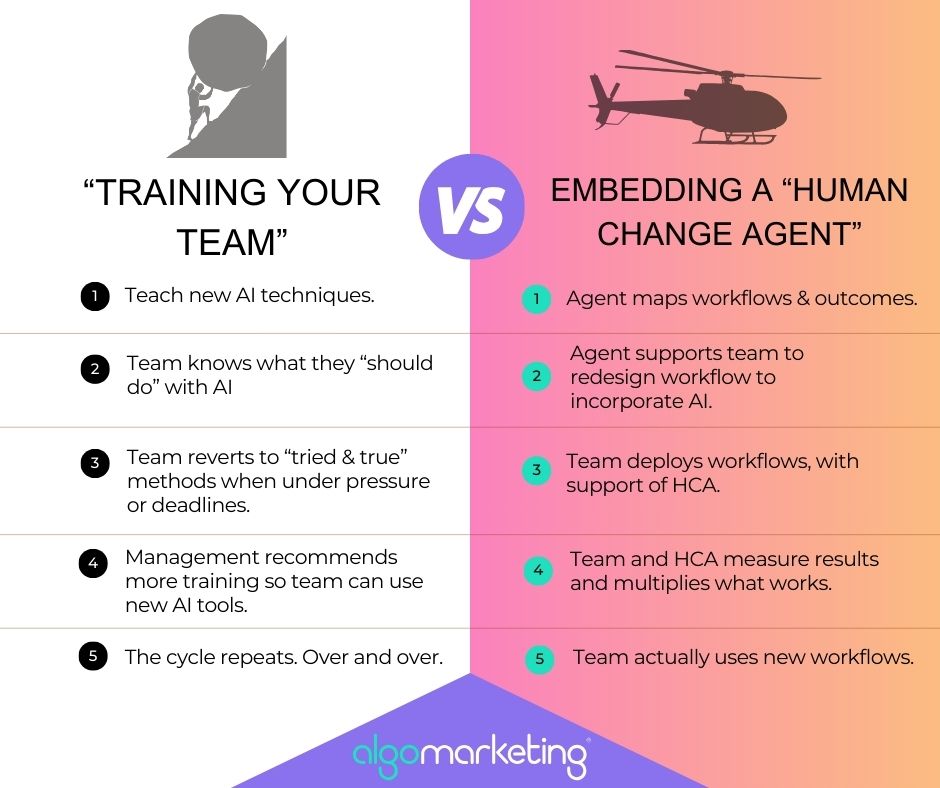
The Human Change Agent Model: Embed AI Proficiency Instead Of Teaching It
Let’s look at what happens when you embed people already at the top of the mountain directly into your teams…
But first, a quick definition:
What Is a Human Change Agent?
A Human Change Agent (HCA) is an AI-native marketer, product manager, or operator who embeds inside your team for a fixed period (typically 3–6 months).
Their job isn't to "do all the AI stuff".
Sure they will do that too…
But their real job is to transform how your existing team works by redesigning their workflows so AI is baked into every step.
Here's how it works in practice:
Step 1: Map Real Workflows
The HCA doesn't start with any kind of generic "training".
They start by collaborating with individual team members on projects they're ALREADY working on.
The conversation sounds like this:
"Let’s walk through some things you're working on this week. What’s eating up the most time?"
They seek to understand their current workflows so that they can help transform them to become faster and easier….
While also creating more potent deliverables.
They’ll see the exact process for your content manager uses to draft a blog post.
How your email marketer builds a campaign.
How your analyst pulls together a performance report.
Then they map the actual workflow.
Step by step.
No assumptions or theory needed.
Just:
"Here's how this person currently does this task."
And then the HCA asks:
"What part of this do you WISH you didn't have to do manually?"
That's where the transformation starts.
Step 2: Redesign the Workflow with AI
Once they understand the current state...
The HCA redesigns it.
Not with generic advice like "use ChatGPT or Gemini to help execute this step".
But with a specific, role-relevant AI-enabled workflow that the team can start using tomorrow.
Examples:
→ A custom Gem that generates first-draft blog posts using your brand voice and internal research docs
→ An automated Google Apps Script that vets event attendees and sends personalized invites at scale
→ An AI Studio Application that identifies high-potential accounts just below your engagement threshold and recommends specific actions to convert them
HCAs aren’t here to give mere prompts that “bolt on” to existing workflows…
They create production-ready solutions that get used to completely transform how the work gets done.
Step 3: Deploy, Measure, and Multiply
The HCA doesn't just build the solution and walk away.
They help the team first to use it.
Then to refine it.
And to measure the impact through each iteration.
Then they document it so it’s clear to all stakeholders:
- What workflow was transformed
- What solution was built
- What impact was achieved (time saved, output increased, cost reduced)
- Who else could use this (or something similar)
The combined elements of streamlined manual processes alongside improved KPIs create the conditions for viral adoption across the team.
People are pulled into adoption and the desire to learn more…
As opposed to being pushed through yet another generic training on AI.
When colleagues see a team member producing twice as much in half the time...
They don't need a training session.
They need the workflow that made it happen.
And the HCA can help them adapt it for their roles too.
Why This Model Actually Works (When Training Doesn't)
1. Peer Influence > Top-Down Mandates
People don't adopt AI because leadership says so.
They adopt it because they see their peers winning with it.
When your team sees a colleague getting measurably better results...
That's when adoption goes viral.
2. Workflow-First > Tool-First
Most AI adoption efforts are tool-first:
"Here's Gemini. Go use it."
The HCA model is workflow-first:
"Here's how you currently build an email campaign. Let's rebuild that process with AI baked in."
The tool becomes invisible.
The workflow becomes the default.
3. Embedded > External
Consultants and trainers are visitors.
They show up. Give advice. Leave.
Human Change Agents are colleagues.
They sit in your Slack channels.
Join your standups.
Work on your actual campaigns.
They're not "the AI person."
They're the person who happens to rebuild everything they touch with AI... and brings the team along for the ride.
4. Reusable Playbooks > One-Off Wins
Every workflow transformation becomes a reusable asset.
A documented case study.
A custom Gem.
An automation script.
These aren't locked in someone's head.
They're in your internal wiki. Your shared drive. Your Gem library.
Ready to be cloned, adapted, and scaled across teams.
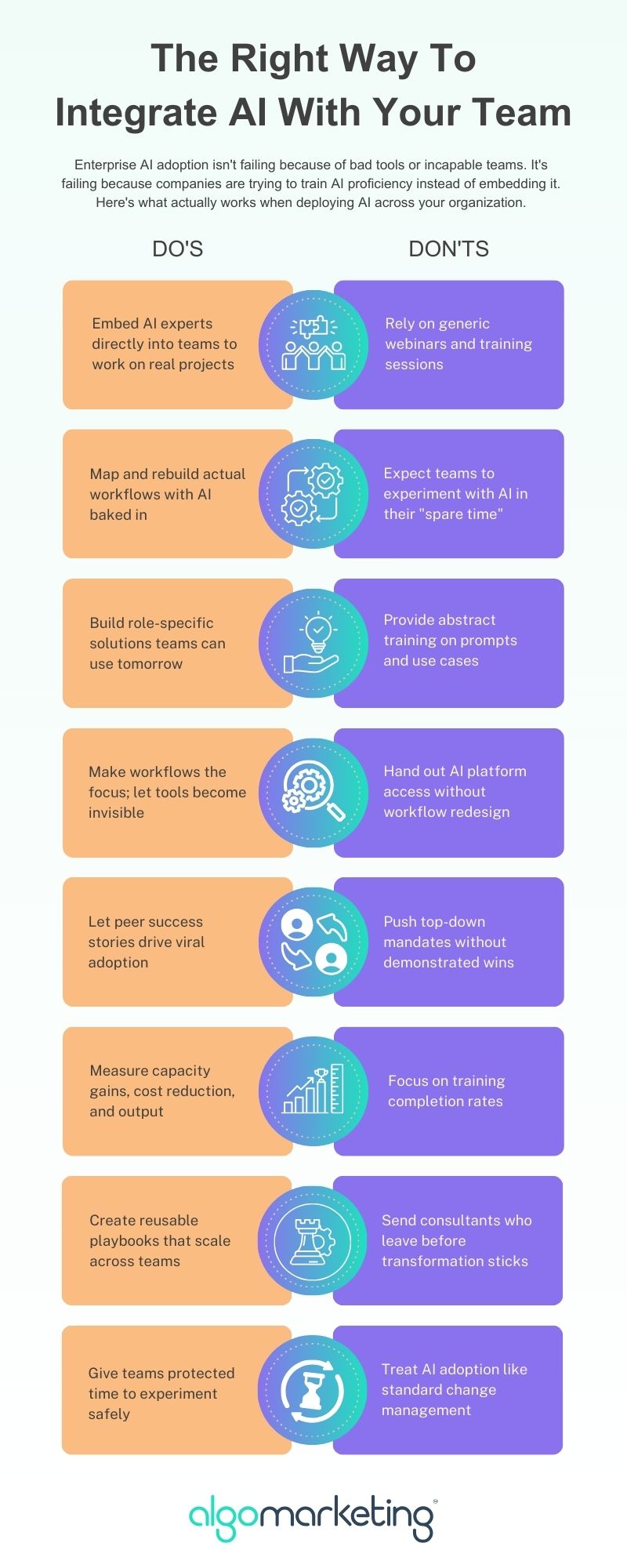
What a 3-Month Human Change Agent Pilot Looks Like
Here's how we typically structure engagements to embed Human Change Agents into enterprise organizations:
Core Team:
The best fit Human Change Agent (or Agents) are embedded in your marketing team for 3 months.
Key Deliverables:
1. Workflow Transformation for Priority Team Members
1:1 sessions with individual marketers, analysts, operators, and managers.
Map their current workflows.
Redesign 1–2 high-impact workflows per person with AI baked in.
2. Production AI Solutions
A portfolio of Gems, agents, automations, and workflows for daily use by your team.
Not prototypes. Not "cool demos."
Real solutions that are doing work.
3. Documented Use Cases & Transformations
3–5 case studies per month.
Each one includes:
- The workflow we transformed
- The solution we built
- The measurable impact (time saved, output increased, cost reduced)
- Who else can use this (role, team, region)
These become your internal "viral adoption toolkit".
4. End-of-Pilot Impact Report
Includes:
What was built.
What impact was achieved.
Recommendations for further scale (i.e. add a second HCA, expand to other teams, etc)
How We Measure Success
We don't measure "activity".
We measure impact.
Specifically, we align upfront on a focused set of metrics in these categories:
Capacity & Headcount Flexibility
→ Ability to handle peak volume without additional hires
→ Evidence that existing team can do more with the same FTE count
Cost & Vendor Efficiency
→ Reduced spend on agencies for tasks now handled in-house with AI
→ Fewer external briefs for low-value, repetitive work
AI Adoption & Engagement
→ Daily/weekly active use of AI solutions (Gems, agents, flows)
→ Number of team members with multiple AI-enabled workflows in regular use
Productivity & Output
→ Hours saved per person per week on target workflows
→ Increased output (e.g., number of assets produced in a given timeframe)
→ Reduced time from brief to first draft to launch
We propose baseline vs. post-pilot comparisons on a realistic subset of these.
This Is Beyond “AI Services”. This Impacts Your Talent Strategy.
We aren’t interested in competing in the “AI services” category.
There isn’t enough true transformation there to get us excited to build and serve each day.
We’re offering a talent strategy that actually works in today’s work landscape.
Most companies approach AI adoption like a change management problem.
They think: "We need to train our people."
But AI adoption isn't like rolling out a new CRM.
It's a mindset shift.
And you don't shift mindsets with a Zoom call and a slide deck.
You shift them with influential people who model the change.
That's what Human Change Agents do.
They don't replace your team.
They transform your team.
By working alongside them. On real projects. In real time.
And when the engagement ends?
Your team doesn't go back to the old way of working.
Because the new way is now the default.
They have the workflows. The tools. The case studies. The confidence.
And they've seen it work.
The Fastest Path Forward
We get it.
Embedding any outside expert into your team sounds like a big move.
But here's the reality:
You've already tried the "train your team" approach.
And if it was working as well as you envisioned it would?
You wouldn’t still be reading almost 2,000 words into this article.
If you’re being honest then you know that:
Your tools are underutilized.
Your team is overwhelmed.
And your AI strategy has stalled in the "good intentions” phase.
Meanwhile, your competitors are figuring this out.
And the gap is widening.
So here's the question:
Do you want to hike up the mountain step by step?
Or do you want to take the helicopter?
If you're ready to actually move the needle on AI adoption...
If you want measurable impact in 90 days, not 18 months...
If you're tired of "AI theatre" and ready for AI that actually does work...
Then let's talk.
We’re ready to deploy HCAs to transform your team’s workflows and build production-ready AI solutions custom to them.
You could be a few short months away from undeniable and measurable proof that this model works.
And from there?
You’re operating from a position of strength on how you scale it and expand it to other teams.
Ready to Move Faster?
Book an introductory strategy call with our team.
We'll walk through your current AI adoption challenges…
Identify 2–3 high-impact workflows we'd target in a pilot…
And show you exactly what a 3-month engagement would look like.
No hard sell.
Just a real conversation about what's possible.
Frequently Asked Questions
Q: How is this different from hiring an AI consultant?
Consultants give advice. They show up, run workshops, deliver a deck, and leave.
Human Change Agents do the work. They sit inside your team, work on real campaigns, and transform workflows from the inside out.
They don't "advise." They build.
Q: What if my team resists having an "outsider" embedded?
That's why we call them Human Change Agents.
They're not coming in as "the AI expert who's here to tell you what to do"...
They're coming in as a colleague who happens to rebuild everything they touch with AI.
They work with your team. On their projects. Solving their pain points.
Resistance melts when people see a peer getting measurably better results.
Q: What happens after the 3-month pilot?
You have options:
→ Extend the engagement with the same HCA
→ Add a second HCA to another team or region
→ Scale the model using your own internal "AI champions" (we can help train them)
→ Do nothing (you'll still have the workflows, case studies, and solutions we built)
The goal isn't dependence. It's capability transfer.
Q: How do I know this will work in my organization?
You don't. Not until you try it.
That's why we structure this as a pilot.
3 months. Fixed scope. Clear deliverables.
At the end, you'll have data. Case studies. Measurable impact.
Then you can decide if it's worth scaling.
But here's what I can tell you:
This model has worked at Google. At enterprise SaaS companies. At agencies.
Across marketing, product, and ops teams.
The common thread?
Organizations that were tired of "AI strategy" that didn't move the needle...
And ready to try something that actually works.


